31.12.14

RECYCLER III_ consumer salvage


ReCYCLER III explored ideas around found and repurposed common objects, and what we considered specific to industrial and consumer culture. These items are all around us, either as part of what we use daily or facilitators in delivering the products of contemporary life. The industrial palette is one such by-product of consumerism. With limited lifespans, once useful integrity expires, many end up either being broken down for second uses or relegated to the landfill. adaptLAB viewed this as an opportunity to explore secondary, public use of this discarded material.


Additionally, we are faced with conflicting choices in the products we buy and consume. On one hand convenience is an expectation in life today and yet, the volume of discarded materials in plastics, paper, etc. instigating resource and environmental consequence, to the extents we are just beginning to understand in terms of future impact. 

In quick summation, the studio proposed a reassembly of found materials as an educational lesson in public, acknowledging the implications of consumer impacts on the environment. In reusing basic materials of plastics and wood, we have found that second generational use go beyond function, but serve as experiential tools for raising and quite literally 'delivering' sustainable awareness. 


ReCYCLER III_ public assemblies


Decommissioned palettes are structurally reinforced and reconfigured as functional public surfaces. 


ReCYCLER III_ space and material studies


Green supplements to the palette structure are complimentary within the public park setting of the installations first local site.


ReCYCLER III_ fabrication documentation


Palettes are fashioned as vessels for containing planting boxes and removable planting cups. Horizontal surfaces are  both planters and places for public seating. 


ReCYCLER III_ community share


The implementation of green wall becomes a focal point for community interaction and collaboration. Its long term sustenance will require input from anonymous volunteers; taking and replacing the 'portable greens' in to-go, plastic cups. The installation itself conceived as reposition-able and unitized ability to be relocated as required. 


29.12.13

R e CYCLER II_ public facility/ grid work


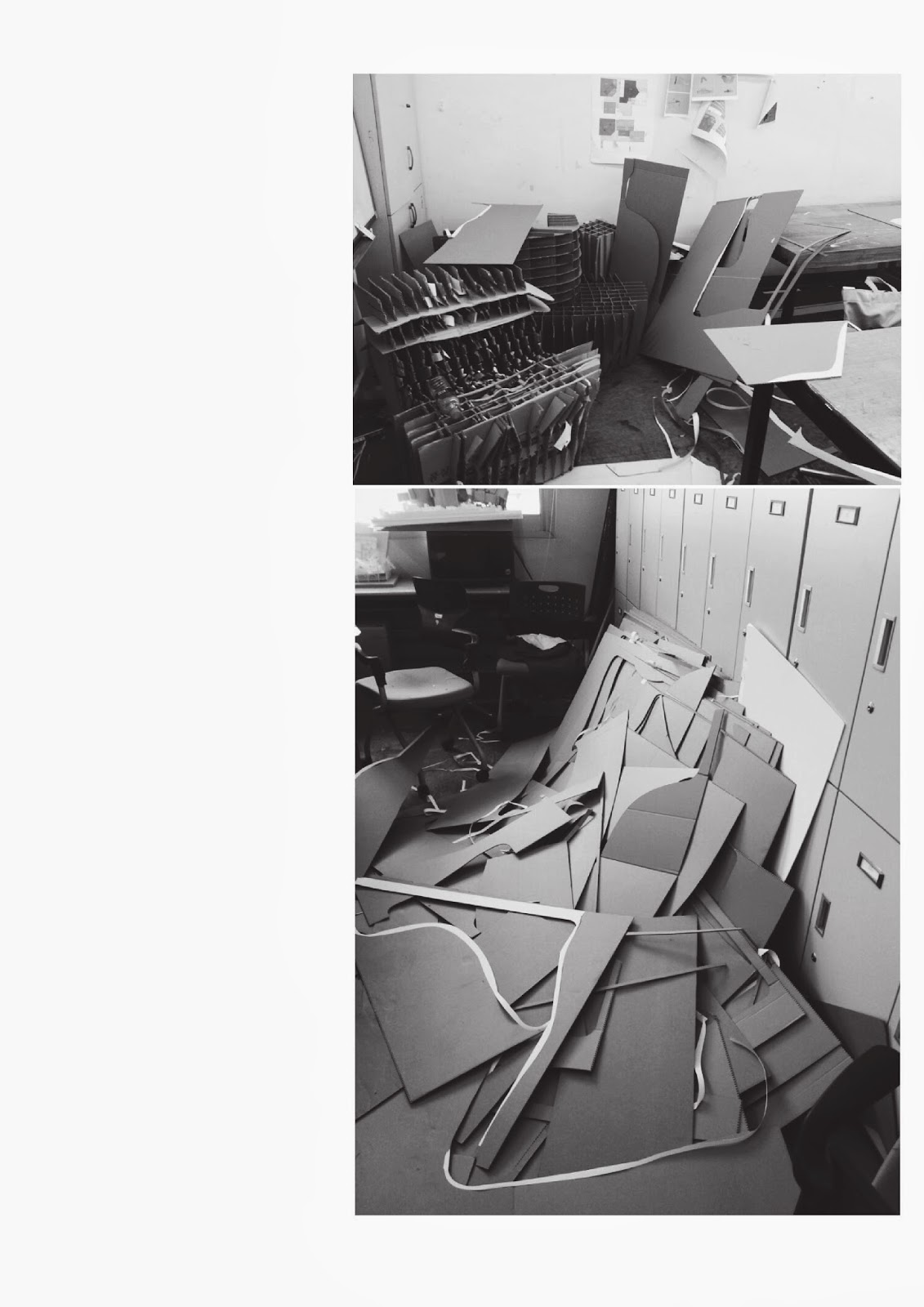
ReCYCLER II explores form generation based on basic principles of material re-use to be deployed with variations of basic grid systems and structures. Although the initial form of grid will be quite simple, the task will be to build complexity though site and place awareness and the combination of scaled variables utilizing cardboard material. As the first ReCYCLER studio began, we consider recyclable or readily salvageable materials to be viable in contemporary design. 


Public library on the Konkuk University campus 


R e CYCLER II_ grid experiments


Optimal dimensions of grid are studied to determine structural integrity based upon dimensions of material arrangements. Cardboard (outside of the ubiquitous cardboard box) is by many accounts an unlikely material for structural support, specifically that for public furniture.


R e CYCLER II_ public form

Dimensional and formal arrangement considers public interaction- both in terms of the collective and the individual- became imbedded as part of the final design. Geometry, in essence, defines together and apart possibilities. 


27.12.13

R e CYCLER II_ installation opening

Exhibition of works opening by the adaptLAB studio/ summer 2013.


R e CYCLER II_ public installation

A cardboard-grid provides seating surface and a place for informal meeting in the main public galley of the public library on the Konkuk University campus. 


\

13.12.12

R e CYCLER introduction


R e CYCLER_ studies

The objective of our condensed summer studio was to design and construct a multi-functional inhabitable 'unit' for outdoor use using salvaged and recycled materials exclusively. To begin, students prepared studies in ergonomic dimensions comparing various elevations of different seating arrangement/ type. 


R e CYCLER_ salvage/ design

Utilizing materials left over from the summer 2011 Mullae studio, students took apart the remaining Mullae fabrications and agreed upon the reuse of heavy gage steel pipe, steel cable and plastic tarpoline. Threading and joint fittings allowed the individual pieces to be securely assembled together. Structurally sound and capable of withstanding high volume use in outdoor spaces of inclement weather scenarios.


salvage operation:


R e CYCLER_ fabrication and testing


Arrangements and fabrications were made in a controlled indoors environment during the summer monsoon of July/ August. The work was completed in sequence from design, salvage of materials, fabrications and installations- over a five week intensive period. 


fabrications:


testing arrangements:


Projections screen:


R e CYCLER_ flexible installation

Ambiguity of function through form manipulation and configured relationships. 

Autonomous 'pieces' independently provide seating essentials, impromptu table surfaces, spatial dividers- amongst other to be discovered uses. The furniture 'objects' are open to reconfigurable possibilities in making outdoor commons space for the college of architecture students. 


R e CYCLER


participating students:


studio advisor: 
Eric Reeder

participating reviewers: 
Sanghun Lee
Marc Brossa

14.6.12

Preservative Measures_ SAEWOON Market


'PRESERVATIVE MEASURES'

A momentary installation \\\\
Eric Reeder + Boris Oicherman


Painted City
Seoul today by its self imposed regulation is a city of beige. Color emerges in limited quantity most commonly associated in districts of commerce or industrial activity. Color in its sparsity, is inter-woven as a function specific feature, practical or otherwise and in Seoul, programmatic in demarcation. Color has rendered the city of Seoul a map of ‘zones’ to be analyzed and interpreted. Blue; the color of industry as seen from above, in recent years has increasingly become obsolete within the political confines of central Seoul. Color is becoming the beige of everyday expectation, a pacified neutral condition. 


Saewoon Market from above. Light industrial practice evident in blue metal roofs and colored plastic awnings.